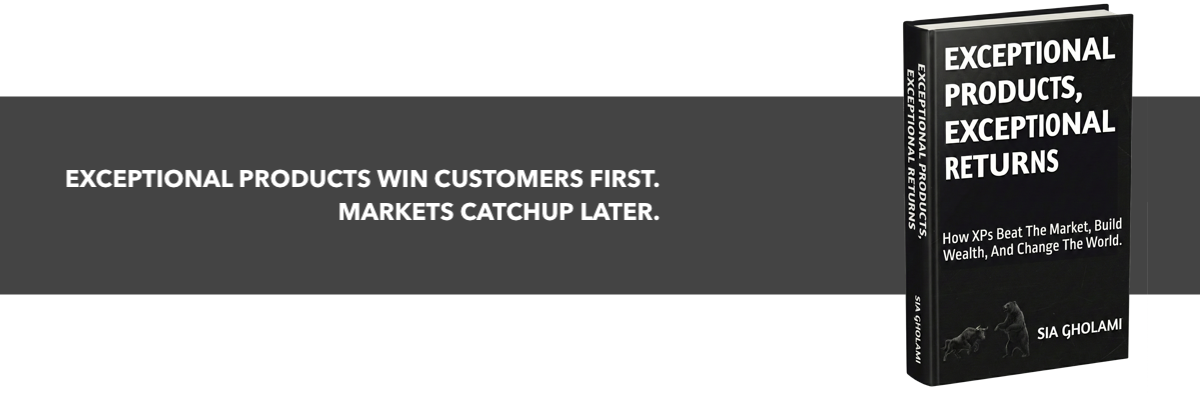
Exceptional Products, Exceptional Returns
Synopsis

This book is about a simple idea. Over the long term, a small number of truly Exceptional Products drive most of the value in the world and in the stock market. If you can learn to spot these products, and own them with patience, you can do better than simply buying the market and hoping for the best.

I call them XPs, short for Exceptional Products.

Part 1: What Are XPs

A working definition of an Exceptional Product

In this book, an Exceptional Product must pass five tests at the same time:

  1. It exists and works today.
    You can buy it now, use it now, or see others using it in real life. It is not vaporware, not “coming soon,” not a demo on stage.
  2. It has strong sales growth.
    Top line revenue is growing at a healthy double digit rate, especially once the product is at meaningful scale. Accounting can play games with earnings, but sales are much harder to fake.
  3. Customers deeply love it.
    People recommend it unprompted, build habits and workflows around it, and get upset when it breaks or goes away. There is real emotional and functional attachment, not just polite satisfaction.
  4. It has no real competition in practice.
    There are always alternatives on paper, but in the real world one product is far ahead. It has a meaningful gap in quality, results, or ecosystem. If it vanished, customers would not see many true substitutes.
  5. It sits in a growing market.
    The product is riding a bigger wave. The number of users, use cases, and dollars in the category are still going up over time, not shrinking or stuck.

All five conditions must be true, not just one or two. That is why true XPs are rare.

The first part of the book teaches you how to separate real products from stories and announcements. It shows how often companies sell “roadmap theater” instead of working systems and how easy it is to get excited about demos that never turn into daily usage.

The book then goes deeper into each XP criterion.

  • Growth is treated as proof of product truth.
    If sales are growing fast at scale, something important is happening. The book explains why revenue growth is a cleaner signal than engineered metrics like “adjusted EBITDA” and why you should be careful to separate smooth compounding from hype spikes.
  • Customer love is seen in behavior, not slogans.
    You look for repeat usage, strong retention, people organizing their work around the product, and even “angry love” where users complain because they depend on it so much.
  • No real competition is about real world moats.
    The book explains network effects, switching costs, ecosystems, and trust based on performance. It asks hard questions such as “If this product disappeared, what would customers realistically move to, and how painful would that be”
  • Growing markets matter because even a great product struggles in a shrinking pond.
    XPs often expand their markets by turning non users into users and by creating new categories that did not exist before.

Part 2: How Markets Treat XPs

If XPs are so powerful, you might think the market would recognize them quickly and price them perfectly. The evidence says otherwise.

Underpricing XPs most of the time

The book argues that markets have a hard time valuing XPs because their long term impact is uncertain and does not fit neatly into short term models.

Common patterns include: New categories are treated as small niches long after they have broken out. Analysts focus on the next quarter, while the real value of an XP sits ten years out. Accounting rules miss the most important assets, such as brand, network, and ecosystem.

You see this in examples where Google traded on the same kind of multiples as Yahoo for years, or where Facebook, with far stronger network effects, was valued below LinkedIn on a P/E basis early on. Payment networks like Visa and Mastercard were valued like regular financial stocks even though their business model and growth prospects were very different.

The XP lens helps you see why these gaps exist. The market sees “another portal” or “another social network” or “another financial stock.” You see a core product that is pulling away, with deep customer love and a long runway in a growing market.

Sometimes the market overshoots

The book also warns that even good XPs can become too expensive. There are times when excitement runs ahead of reality. Investors price in perfection, assume endless growth, zero competition, and flawless execution. Even a great product cannot live up to that.

You see this in bubbles, such as parts of the dot com era, or in moments when strong companies trade at prices that assume the next ten years will be as easy as the last ten. The book explains how to respect valuation, even when you love the product.

Critics, stories, and your own framework

There is always a chorus of critics who say “It cannot go higher,” “Everyone who wants this already has it,” or “Competition will crush margins any day now.” The book collects real quotes from industry experts who dismissed the iPhone, misread Google, or called Netflix a niche.

The lesson is not that experts are stupid. Many are smart and hard working. The lesson is that their incentives and time horizons are different.

The book shows you how to build your own framework so that: Headlines and opinions become inputs, not commands. You can compare what others say with your own view of product truth, growth, moats, and markets. You are less likely to sell an XP too early or chase it at any price.

How to act on all this

The strategy that comes out of the book is simple to say and hard to follow:

  1. Use the XP checklist to find real Exceptional Products.
  2. Buy them at reasonable valuations.
  3. Hold them through volatility, as long as they remain XPs.
  4. Sell when they stop being XPs or when the price clearly assumes the impossible.
  5. For most of your money, use simple index funds and treat XP investing as a focused, long horizon effort.

You are reminded many times that this is not risk free. XPs can stumble. Prices can drop 50 percent or more. You have to be able to live with that.

The promise is not a perfect system. It is a more honest way to look at the world. Focus on real products, real customers, and real markets, and you will already be ahead of many people who spend their days staring only at screens.

Buy Now on Amazon